By Mirjana Dobric
When it comes to calorie-burning workouts, how you move matters just as much as how long you move. Pilates has earned its reputation for improving posture, flexibility, and core control through mindful, low-impact movement. Lagree Fitness takes that foundation and amplifies it—layering in higher intensity, strength, and endurance to create a workout that is still joint-friendly, but far more demanding metabolically.
If your goal is weight loss, body recomposition, or maximizing results in limited time, understanding the difference between Pilates and Lagree is key. Let’s break it down clearly, credibly, and realistically.
What Is Pilates—and What Does It Burn?
Pilates is a low-impact exercise method focused on controlled movement, breathing, alignment, and core strength. Classes can be performed on a mat or on equipment like the Reformer, which adds resistance through springs.
Pilates is excellent for:
- Improving posture and flexibility
- Building deep core strength
- Supporting rehabilitation and joint health
- Creating a sustainable, mindful movement practice
Typical Calorie Burn in Pilates (45 Minutes)
Calorie burn in Pilates depends on body weight, experience level, and whether the class is mat-based or uses resistance equipment. The ranges below reflect beginner to general-population classes, not athletic or cardio-Pilates hybrids.
Mat Pilates (Beginner–Intermediate):
- 120 lbs: ~120–140 calories
- 150 lbs: ~150–170 calories
- 180 lbs: ~180–200 calories
- 210 lbs: ~210–230 calories
- 250 lbs: ~250–270 calories
Reformer Pilates (Beginner–Intermediate):
- 120 lbs: ~135–155 calories
- 150 lbs: ~170–190 calories
- 180 lbs: ~200–220 calories
- 210 lbs: ~230–250 calories
- 250 lbs: ~270–290 calories
Important note: These estimates assume controlled pacing, rest between exercises, and a steady heart rate around ~50–60% of max. Individual results vary based on effort, resistance, and conditioning.
Can Pilates Really Help You Burn Calories—and How Lagree Amplifies It
Yes—pilates helps burn calories especially when practiced consistently and paired with nutrition and other activities. Pilates helps build muscle tone, improve movement efficiency, and support long-term adherence because it’s gentle and sustainable.
However, for most people, Pilates alone does not create a large calorie deficit unless combined with higher-intensity training.
That’s where Lagree comes in.

What Is Lagree—and Why It’s Different From Pilates
Lagree is not Pilates, though it’s often mistaken for it.
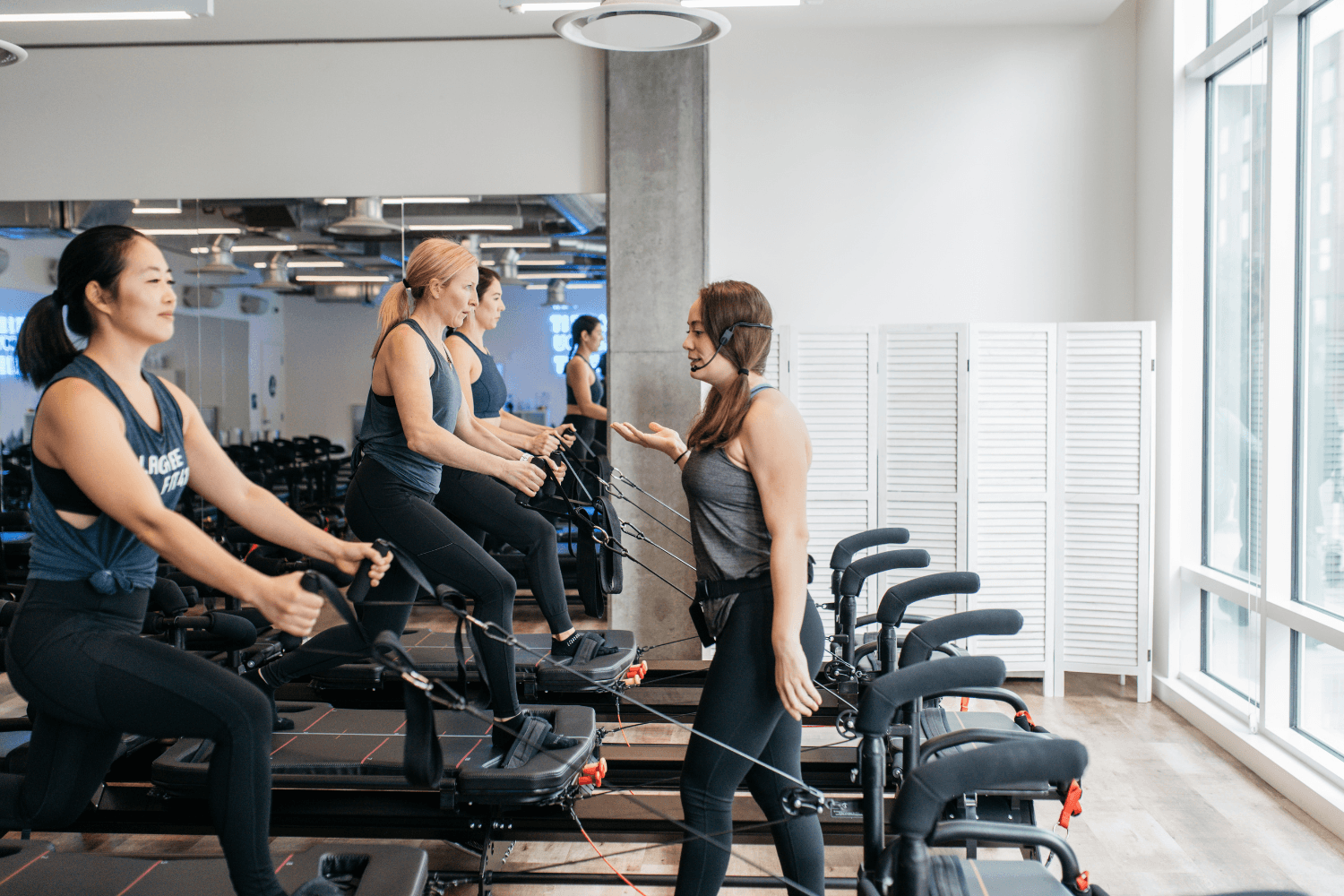
Lagree is a high-intensity, low-impact training method performed on the Megaformer. It combines:
- Strength training
- Cardio demand
- Muscular endurance
- Balance and core control
All in a single, continuous workout with minimal rest.
Why Lagree Burns More Calories (In Plain Terms)
Calorie burn with Lagree is increased through several key mechanisms:
- Time Under Tension
Muscles stay engaged for long, continuous intervals—often 60–120 seconds per move—without rest. - Full-Body Engagement
Most movements target multiple muscle groups at once (legs, core, arms simultaneously), increasing energy demand. - Elevated Heart Rate Without Impact
Transitions are slow, resistance is heavy, and rest is minimal—keeping your heart rate elevated safely. - Adjustable Resistance
Springs on the Megaformer allow intensity to scale with your strength and fitness level. - Metabolic Afterburn (EPOC)
The intensity leads to increased post-exercise oxygen consumption—meaning your body continues burning calories after class.
Calories Burned in a 45-Minute Lagree Class
Rather than a single number, it’s more accurate to look at ranges, since calorie burn with Lagree depends on:
- Body weight
- Fitness level
- Spring resistance used
- Instructor programming
- Effort and form
Realistic calorie burn for a 45-minute Lagree class:
- 350–550 calories for most participants
- Up to 700–800+ calories for advanced clients using higher resistance and minimal rest
Disclaimer: It’s important to remember that these figures are estimates. Individual results vary based on physiology and effort—but consistently trend higher than Pilates due to intensity and muscle recruitment.
Lagree increases energy expenditure through:
- Extended time under tension (muscles working continuously, often 60–120 seconds per move)
- Simultaneous multi-muscle activation (legs, core, arms at once)
- Elevated heart rate without impact
- Post-exercise oxygen consumption (EPOC), meaning calories continue to burn after class
Pilates vs. Lagree: Which Should You Choose?
Choose Pilates if your primary goal is:
- Improving posture and mobility
- Rebuilding strength after injury
- Reducing stress through mindful movement
- Supporting long-term joint health
Choose Lagree if your primary goal is:
- Burning more calories in less time
- Losing body fat and building lean muscle
- Increasing strength and endurance
- Seeing visible changes faster
The sweet spot? Combine both.
Many clients use Pilates to refine movement quality and Lagree for strength to drive metabolic results.
How Often Should You Do Lagree for Weight Loss?
For most people:
- 2–3 Lagree classes per week = strong fat-loss and toning results
- 3–4 classes per week = accelerated recomposition (with adequate recovery)
To track progress, focus on:
- Strength increases (heavier springs, longer holds)
- Improved endurance
- Body measurements and how clothes fit—not just the scale
How to Maximize Calorie Burn with Lagree
- Wear grip socks for stability and safety
- Focus on slow, controlled movement—speed reduces effectiveness
- Progress resistance gradually
- Prioritize form over reps
- Stay consistent; results compound over weeks, not days
Why Calorie Burn Isn’t Everything—but Still Matters
While calorie burn is important for weight loss, Lagree also delivers:
- Lean muscle development (which raises resting metabolism)
- Improved posture and core strength
- Joint-friendly training with minimal impact
- Long-term sustainability without burnout
Pilates lays the foundation. Lagree builds the structure.

The Bottom Line: Pilates vs. Lagree
Pilates is an excellent, credible, and valuable practice—especially for control, flexibility, and longevity. Lagree takes those principles and layers in strength, intensity, and efficiency. You’ll have an amazing calorie burn with Lagree—making it one of the most effective low-impact workouts for body transformation.
If you’re ready to work smarter, not harder—and see results without wrecking your joints—Lagree is worth experiencing.
Book your first class at Lagree Fit 415 and discover what your body is capable of.
Sources: