By Danielle Rosario
It’s normal to wonder whether your workouts are working, especially when progress is not immediately visible. You may be attending class consistently and challenging yourself on the Megaformer without seeing a dramatic change on the scale.
That does not mean your effort is not paying off.
Lagree results do not always show up where people expect them to. Sweat and soreness can make a workout feel effective, but neither is a reliable measure of progress. How much you sweat can depend on temperature, hydration, and genetics, while soreness often decreases as your body adapts to training.
The clearest signs of progress are often more practical. You may have more energy, maintain better form, hold positions longer, use more challenging spring settings, or feel more confident during class. These physical, performance-based, and mental changes can reveal how Lagree is changing your body long before the results are obvious in the mirror.
Why Lagree Results Can Be Hard to See at First

Your body begins adapting to exercise before those changes become visible.
During the first several weeks of resistance training, strength gains often come from neuromuscular adaptation. Your brain and nervous system become more efficient at recruiting muscles, coordinating movement, and maintaining control under resistance.
This is especially important in Lagree, where slow tempo, balance, stability, and muscular control are central to every exercise. You may become better at performing a movement before you notice visible muscle definition.
Lagree also relies heavily on time under tension. Instead of moving quickly through repetitions, you keep the working muscles engaged for an extended period. This develops strength and muscular endurance while improving your ability to maintain control as fatigue builds.
Many people begin noticing clearer strength gains within approximately six to eight weeks of consistent resistance training, although timelines vary based on experience, recovery, nutrition, and class frequency. Changes in body composition often take longer.
Understanding this process can prevent you from quitting too early. Progress may already be happening, even when it is not yet visible.
Physical Signs Your Lagree Workout Is Working
You Have More Energy
A challenging class may leave you temporarily tired, but regular exercise should eventually support your overall energy.
Exercise encourages the body to produce more mitochondria within muscle cells. These structures help convert oxygen and nutrients into usable energy. As your body becomes more efficient, you may feel less sluggish, more alert, and better able to handle daily activities.
Pay attention to whether you have more energy at work, recover more quickly after class, or feel less drained later in the day.
You Experience Less Pain and Better Sleep
Improved strength and movement control may reduce certain everyday aches and stiffness. Lagree strengthens the core, hips, shoulders, and stabilizing muscles that support your body during daily movement.
You may notice that getting out of bed feels easier, your lower back feels more supported, or you experience less stiffness after sitting for long periods.
Regular exercise may also improve sleep quality. You might fall asleep more easily, wake less often, or feel more rested in the morning.
Persistent or worsening pain should always be discussed with a qualified healthcare professional. However, improved comfort during normal movement can be a valuable sign of progress.
Your Posture Is Improving
Lagree challenges the muscles responsible for core stability, spinal support, and shoulder positioning. Planks, rows, lunges, and kneeling exercises require you to maintain alignment while moving under resistance.
Over time, you may notice less rounding through your shoulders, better head positioning, or a greater ability to sit and stand upright without forcing it.
Better posture often develops alongside improved body awareness. You begin to recognize when your shoulders are creeping forward or your core has disengaged and correct the position more naturally.
Your Clothes Fit Differently
The scale does not tell the full story of your progress.
As you build muscle and reduce body fat, your weight may remain relatively stable while your shape changes. Your clothes may fit differently through your waist, hips, legs, or shoulders before the number on the scale moves.
This is one reason non-scale wins are important. Body recomposition can happen even when your body weight changes slowly.

Performance Signs Your Lagree Workout Is Working
Exercises Feel More Manageable
When a movement that once felt impossible becomes more controlled, that is a sign of progress.
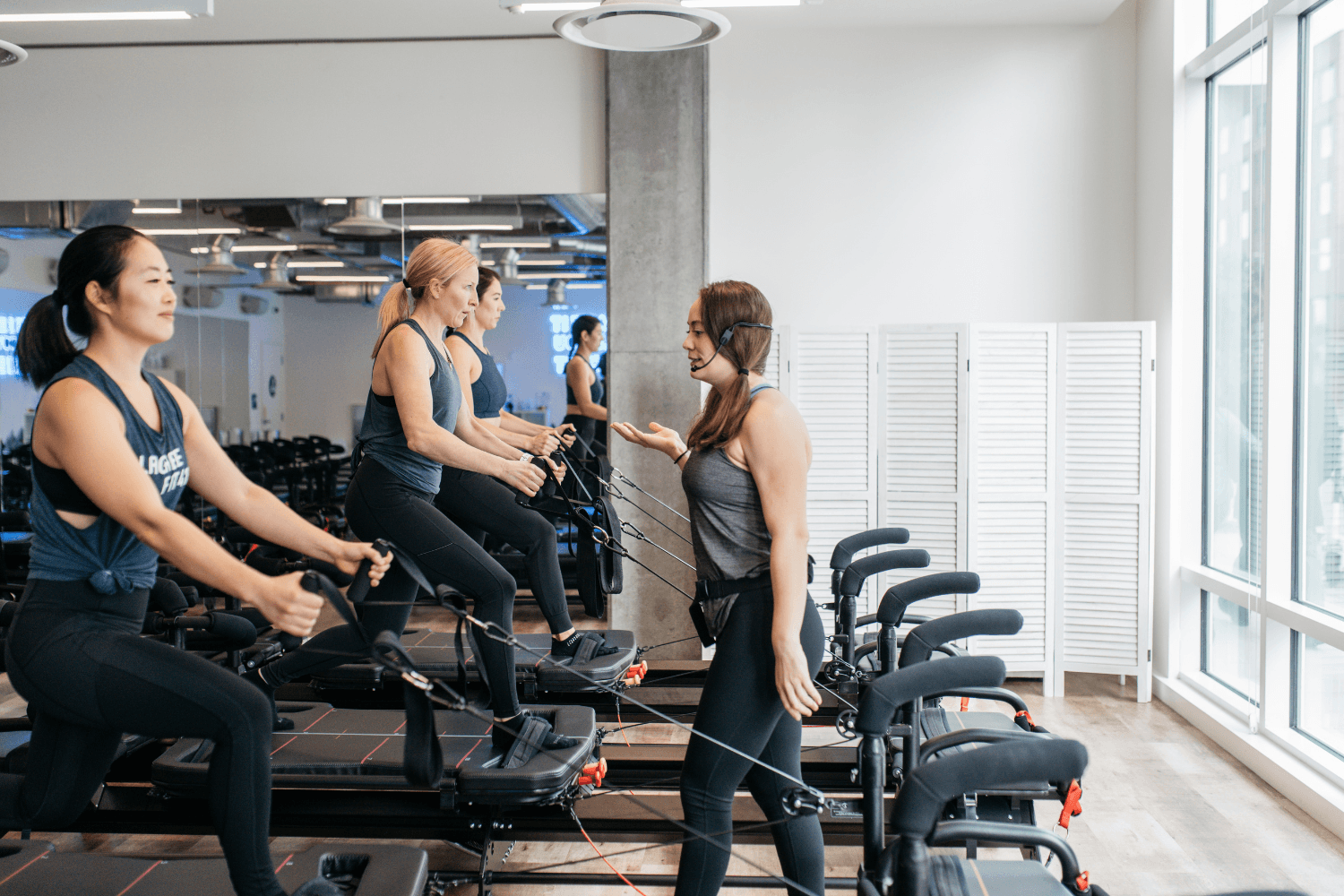
You may rely less on the handlebars, move through transitions more smoothly, or maintain a slow tempo without rushing. You may also feel less overwhelmed by the pace of class because you understand the exercise setup and cues more quickly.
The goal is not for Lagree to become easy. It is to become more capable of handling the challenge.
You Can Maintain Form for Longer
Improved form is one of the clearest signs that your strength and endurance are increasing.
You may be able to complete more of a set without resetting your position, dropping your knees, or shortening your range of motion. You might hold a plank longer or stay lower in a lunge without losing control.
Completing a movement with strong form for 40 seconds instead of 20 seconds is meaningful progress, even if you are using the same spring setting.
Your Time Under Tension Is Increasing
Lagree is not about completing the highest number of repetitions. It is about maintaining slow, controlled movement under tension.
You may notice that you can move more slowly, hold the most challenging part of an exercise longer, or complete a full set without releasing tension.
These improvements show that your muscles are becoming stronger and more resistant to fatigue.
Your Instructor Offers Progressions
Your instructor may recognize your progress before you do.
They may begin offering you advanced variations, additional resistance, elevated positions, or a slower tempo. This usually means they have noticed improvements in your control, alignment, and overall strength.
You do not need to take every progression. Maintaining proper form should always come first. Still, being offered more challenging options is a strong signal that you are improving.
Lagree-Specific Progress Markers to Watch For
Lagree has several progress markers that are unique to the method.
The Shake Arrives Later
The Lagree shake often happens when your muscles begin to fatigue under continuous tension.
When you first start, the shake may appear early in a set. As your muscular endurance improves, you may notice that it takes longer to arrive.
The shake is not the only measure of an effective workout, but a change in when fatigue begins can help you recognize progress.
Your Spring Settings Have Progressed
Depending on the exercise, progress may mean adding resistance or removing a support spring.
For pushing and pulling movements, a heavier spring may increase resistance. For certain plank-based or lower-body exercises, less spring assistance may make the movement more challenging.
Spring progression should be exercise-specific. More resistance is not automatically better, so follow your instructor’s guidance.
You Can Hold Challenging Positions Longer
Movements such as Bear, Plank to Pike, Wheelbarrow, and other plank variations require full-body control.
You may be able to maintain the position for the entire set without dropping your knees or resetting. In lower-body exercises, you might stay deeper in the movement or rely less on the handlebars.
These are important signs that your core strength, stability, and endurance are improving.
You Can Perform Progressions With Control
Advanced variations may involve a slower tempo, larger range of motion, less support, added resistance, or a more elevated position.
The progression only counts when you can maintain control. Moving through a harder variation quickly or losing alignment does not provide the same benefit.
Quality of movement matters more than choosing the most difficult option.
You Can Self-Modify Intelligently
As your body awareness improves, you become better at recognizing what you need during class.
You may know when to shorten your range of motion, adjust your spring setting, use the handlebars, or return to a foundational variation. You also begin to understand the difference between productive muscle fatigue and discomfort that requires an adjustment.
Choosing the right version of an exercise for your body is a skill, not a setback.

Mental and Emotional Signs Your Lagree Workout Is Working
You Feel Happier and More Focused
Exercise can support mood, concentration, and stress management.
You may leave class feeling calmer, mentally sharper, or more emotionally balanced. You might also notice that it is easier to focus at work or move through your day with less tension.
These mental benefits are valuable forms of progress, even when they are difficult to measure.
You Look Forward to Class
There is a difference between wanting to attend class and feeling guilty for missing one.
Looking forward to class means you enjoy the challenge, the routine, and how you feel afterward. Guilt makes exercise feel like punishment.
A sustainable Lagree routine should be built around strength, confidence, and self-care rather than fear or compensation.
Your Body Awareness Has Improved
Lagree requires constant attention to form and muscular engagement.
Over time, you may become better at feeling which muscles should be working. You might notice when your core has disengaged, when your shoulders are taking over, or when you are using momentum instead of control.
This stronger mind-muscle connection can improve both safety and performance.
You Feel More Capable
Completing difficult movements can increase confidence in your ability to handle challenges.
Each time you hold a position longer, complete a full set, or try a new progression, you build evidence that you are capable of improving through consistent effort.
That confidence can extend beyond the studio and influence how you approach other goals.
How to Track Your Lagree Progress
Progress is easier to recognize when you record it.
After class, write down the spring settings you used for a few common exercises. Review your notes after six weeks to see whether you are using more resistance or less assistance.
You can also track which exercises you modified and how you modified them. Over time, you may notice that you are taking fewer resets, using a fuller range of motion, or holding positions longer.
Pay attention to instructor feedback as well. Instructors often notice changes in your alignment, control, and endurance before you do.
Other non-scale wins to track include:
- Energy levels
- Sleep quality
- Posture
- Pain or stiffness
- Class attendance
- Time under tension
- How your clothes fit
- Progressions you completed
- How long you held challenging positions
Tracking these details makes progress visible and can help support better workout consistency.
Signs It Is Time to Progress Within Your Lagree Routine
Progress does not always mean changing your entire workout routine. Often, it means adjusting the way you perform familiar movements.
If an exercise consistently feels easy, you may be ready to increase resistance, reduce support, slow your tempo, or expand your range of motion.
If the Lagree shake never arrives and you no longer approach meaningful fatigue, your body may have adapted to your current setup. Slowing down is often the first progression to try because it increases time under tension without sacrificing control.
Completing every set without modifying may also mean you are ready for a more advanced variation.
Talk to your instructor before making major changes. They can observe your form, recommend the right spring setting, and help you progress without losing the slow, controlled movement that makes Lagree effective.
You Are on the Right Track. Keep Going.
Lagree results often show up in your energy, posture, performance, and mindset before they appear in the mirror.
You may notice that the shake arrives later, you can hold Bear for a full set, your spring settings have progressed, or your instructor is offering more advanced options. You might sleep better, feel stronger during daily activities, or walk into class with more confidence.
These signs matter.
Progress is not always dramatic or linear. Pay attention to the small improvements, track your non-scale wins, and give your body time to adapt.
Seeing these signs? Keep the momentum going! Book your next class at Lagree Fit 415.
Sources:
1 How to Know if Your Exercise Program Is Working
2 21 Signs of a Successful Workout That Have Nothing to Do with Sweat or Soreness
3 Harvard Health - Does Exercise Really Boost Energy Levels?
4 19 Signs Your Fitness Routine is 'Working' That Have Nothing to Do with Weight Loss